
The scent of frying oil and overly sweetened soda hung thick in the air, a familiar aroma that always preceded a quick, satisfying meal. I was standing near the pickup counter, my eyes scanning the digital display for my order number to flash, when I felt a tap on my shoulder. I turned, a mild irritation stirring at being distracted from my digital vigil, and found myself facing a woman whose expression was a potent mix of impatience and entitlement.
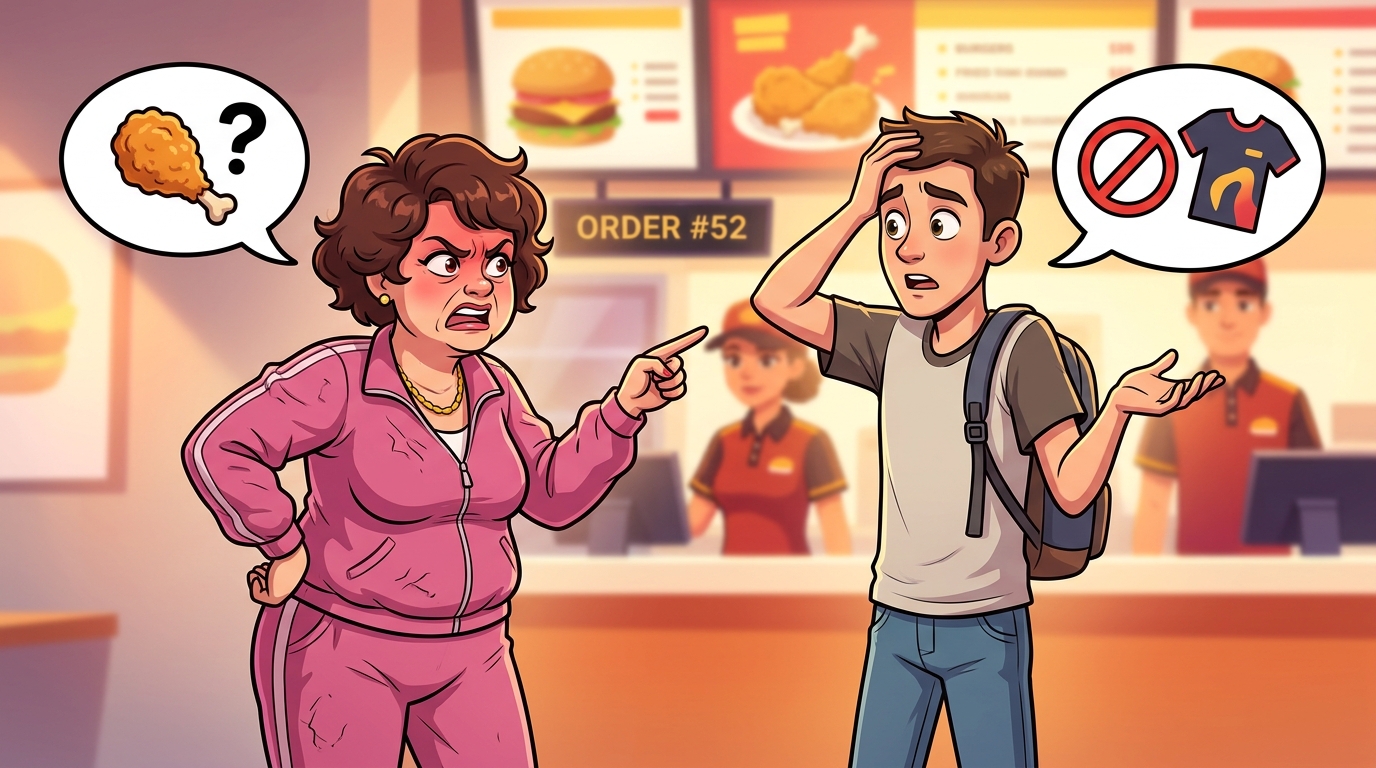
“Excuse me,” she began, her voice sharp, “I’ve been waiting far too long. Could you possibly tell me where the extra crispy chicken strips are? My order is incomplete.”
I blinked, taken aback. My brain struggled to process the question. I was wearing a simple t-shirt and jeans, my backpack slung casually over one shoulder. There was absolutely nothing about my attire or demeanor that suggested I was an employee. “Oh, I’m sorry,” I replied, a slight frown creasing my brow, “but I don’t actually work here. I’m just waiting for my food, like you.”
A sudden, distinct flush began to creep up her neck, staining her cheeks a vibrant crimson. Her eyes narrowed into slits, and a muscle in her jaw started to twitch. “Don’t give me that nonsense,” she snapped, her voice rising in pitch. “You’re standing right behind the counter area, looking at the screens. You absolutely work here. Now, where is my chicken?” Her urgency was palpable, almost desperate, as if the fate of the world hinged on her immediate consumption of fried poultry.
A knot began to form in my stomach. The subtle hum of the restaurant’s ventilation system suddenly seemed deafening. “Ma’am, I assure you, I am not an employee. I’m a customer. The actual employees are wearing uniforms, usually with a specific logo,” I explained, trying to keep my voice even, despite the growing sense of disbelief at her refusal to accept a straightforward fact. I gestured vaguely towards the people behind the service line, who were indeed clad in branded polos. “Perhaps you could ask one of them.”
Her hands clenched into fists, and I could practically feel the heat radiating off her. “This is ridiculous! I don’t have time for your games. I saw you back here. You clearly work here, and you’re being incredibly unhelpful. Just get me my chicken!” The conviction in her voice was so absolute, so unwavering, that for a fleeting second, I almost questioned my own identity. My temples began to throb with a dull ache.
Realizing that rational explanation was a lost cause, and feeling my patience rapidly diminishing, I decided to extricate myself from the absurd confrontation. “Look,” I said, my voice now tinged with an edge of irritation I hadn’t intended, “I will go find someone who actually works here to help you.” I turned towards the main service counter, scanning for an available worker, hoping to quickly delegate this bizarre interaction to someone equipped to handle it.
My attempt to find a legitimate employee, however, only seemed to fuel her rage. She practically lunged forward, grabbing my arm. Her grip was surprisingly strong, an unpleasant vise that sent a shiver down my spine. “You are not going anywhere!” she hissed, her face inches from mine. Her breath smelled faintly of stale coffee. “You are going to help me, or I’m going to make sure you lose your job! I know who the manager is, and they’ll hear all about your disgraceful customer service.”
My muscles tensed, and I felt a surge of indignation. “Get your hand off me,” I stated, my voice low and steady, trying to maintain composure despite the increasing heat in my chest. I gently, but firmly, pulled my arm free from her grasp. At that moment, a young woman in a branded uniform, carrying a tray of drinks, happened to be walking by. I caught her eye. “Excuse me,” I called out, “this woman seems to be having an issue with her order, and she believes I work here.”
The employee, a teenager who looked visibly startled, stopped and looked from me to the irate woman. Before she could utter a word, the woman rounded on me again. “You tattletale! You think you can just pretend you don’t work here and then try to get someone else involved? This is pathetic! I want to speak to your manager right now! You’re going to be fired for this attitude!” Her accusations were a volley of verbal abuse, each one designed to inflict maximum damage, entirely disconnected from reality.
The throbbing in my head intensified. I took a deep breath, trying to steady my racing pulse. “I do not work here. There is no manager for me to speak to. I am just a customer,” I repeated, each word punctuated by a rising sense of exasperation. The teenage employee, sensing the escalating tension, prudently backed away, her eyes wide with a mixture of fear and confusion. She quickly sought out a more senior colleague.
Within moments, a man in a slightly different uniform, presumably a shift supervisor or manager, approached. He had a look of weary resignation already etched on his face, as if he’d dealt with a thousand such situations before. “Is there a problem here?” he asked, his voice calm, directed generally at both of us.
The woman immediately launched into a tirade. “Yes, there’s a huge problem! This… this individual,” she said, pointing a trembling finger squarely at me, “refuses to help me with my order, claims they don’t work here, and then tried to send some child to deal with me! They were incredibly rude and disrespectful. I demand they be terminated immediately!”
The manager listened patiently, occasionally glancing at me, an unspoken question in his gaze. I simply shook my head slightly, my expression a mixture of fatigue and incredulity. When she finally paused for breath, the manager turned to me. “Sir,” he began, “do you…?”
“I do not work here,” I interjected, my voice firm. “I was just waiting for my order. She approached me, insisted I was an employee, and has been refusing to accept my word since then. I tried to direct her to an actual employee, but she grabbed me and made threats.”
The manager’s expression hardened slightly. He turned back to the woman. “Ma’am, he’s correct. He’s not one of our staff. And grabbing other customers is not acceptable behavior.”
This confirmation seemed to trigger an even greater explosion of fury from her. Her face turned an alarming shade of purple. “You’re lying! You’re all in on this! This is terrible customer service! I demand my food, and I demand that he be fired! I won’t leave until this is handled properly!” Her voice echoed through the bustling restaurant, drawing the attention of other patrons, who now openly stared, some with looks of amusement, others with pity.
The manager’s patient demeanor visibly fractured. He pulled out a phone and began dialing. “Ma’am, if you don’t calm down and either accept help from my staff or leave the premises, I’m going to have to call security, or the authorities. This behavior is disruptive and unacceptable.”
She shrieked, a sound that grated on my nerves. “You can’t do that! I’m a paying customer! I have rights! I’ll sue this establishment! I’ll call corporate!” Her threats became increasingly incoherent, a cascade of indignant rage. Within minutes, two uniformed officers from the local precinct arrived, their presence an immediate, sobering hush over the restaurant. They quickly assessed the situation, and after a brief, one-sided conversation with the screaming woman, they calmly but firmly escorted her out, her protests fading into the general din of the street outside.