
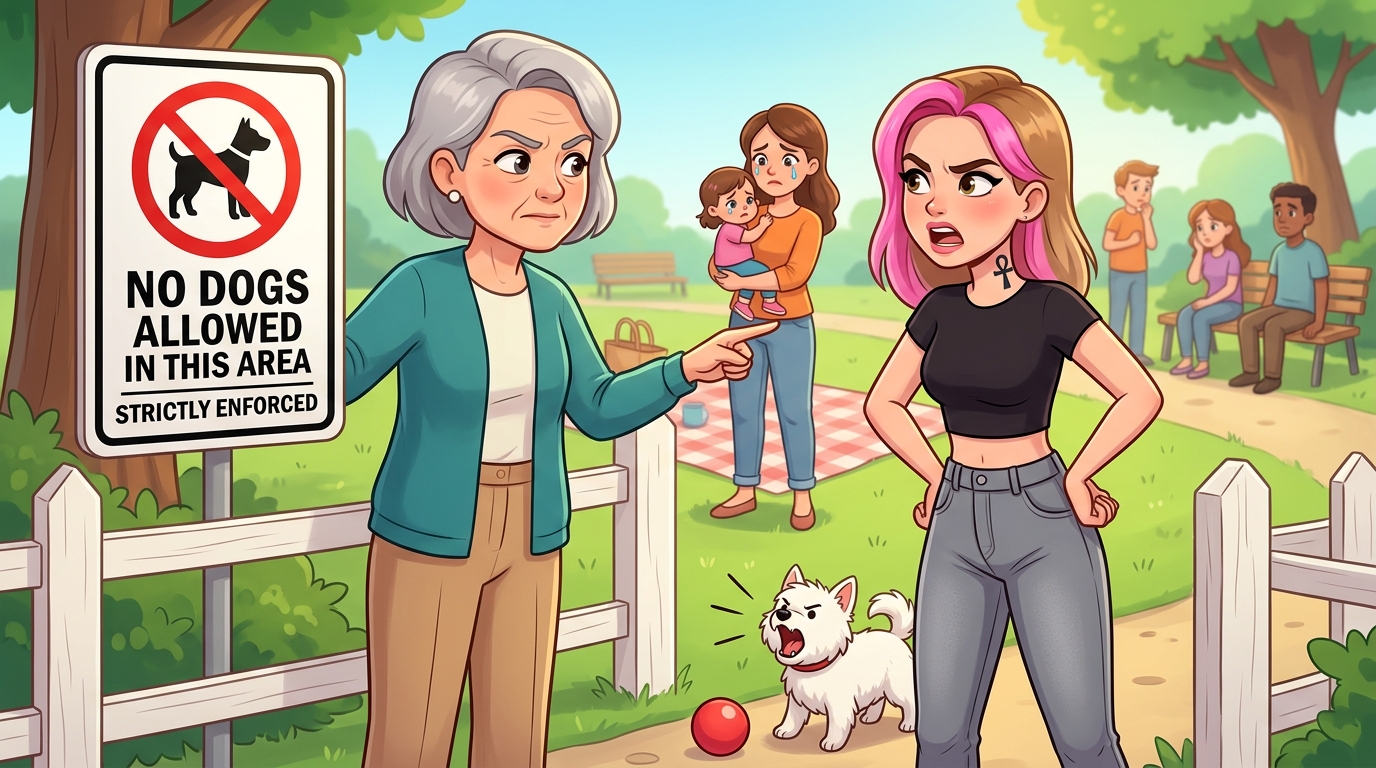
The sun was warm on my skin. I sat on a bench in the park, watching the leaves move on the trees. It was a good day, quiet and slow, just like I liked. People walked by, some with bikes, some with small children. I saw a mother pushing a stroller, smiling at her baby. I liked to come to this part of the park. It had a big fence, and inside the fence, there was a sign. The sign had a picture of a dog with a red line through it. It said, NO DOGS ALLOWED IN THIS AREA. It was a good rule, I thought, because many little children played here.
Then I saw her. She walked into the fenced area like she did not see the sign. She was a young woman, maybe twenty years old. Her hair was light brown, but she had a big, bright pink streak in the front. It was very pink, not mixed well. She wore tight clothes that showed her body. She had a dog, a small fluffy dog, walking right next to her. The dog did not have a leash. She was talking on a small phone, very loud. Her voice was high. She walked like she owned the whole park, her head held up high. I also saw a big tattoo on her neck. It looked like a cross with a loop on top, an old Egyptian symbol. I had seen it in a book once. She kept walking closer to where some children were playing.
The little dog was happy. It ran ahead of her, sniffing the grass. It went near a family having a picnic. The dog barked once. The family looked up, confused. The woman with the pink hair did not seem to care. She just kept talking on her phone, laughing loudly. The little dog then ran to a group of children who were running around. One boy, maybe five years old, giggled and tried to touch the dog. The dog yipped and jumped away, not in a mean way, but like it was scared or surprised. The boy looked sad. His mother quickly called him back.
I watched all this. My eyes followed the dog. It was still off the leash. It went near a lady reading a book. The dog sniffed at her bag. The lady looked annoyed but did not say anything. She just moved her bag away. I thought about the sign, the big red line through the dog. It was very clear. But this woman, she acted like the sign was not there. She finished her phone call. She put her phone in her back pocket. She looked around, like she was waiting for people to look at her. And they did. Many people saw her and her dog, and they saw the sign too.
Then, something happened that made things worse. A little girl, maybe three years old, was playing with a bright red ball. She bounced it and then kicked it a little too hard. The ball rolled fast. It rolled right past the pink-haired woman’s feet. Her dog, the fluffy one, barked very loud, a sharp, quick bark. The woman jumped, startled, and stumbled a little bit on her own feet. She did not fall, but she looked very upset. She glared at the little girl, then at the ball. The little girl’s mother quickly came over, picking up the ball.
The pink-haired woman began to speak, her voice even louder than on the phone. She said that people needed to watch their children. She said her dog was very sensitive. The little girl’s mother tried to say sorry, explaining that it was just an accident. She said her child did not mean to bother anyone. But the pink-haired woman would not listen. She put her hands on her hips. She said the park was for everyone, and her dog had a right to be happy and free. She said that children running around like wild animals were the real problem.
I felt my face get warm. I knew the rules. I saw the sign. She was wrong. She was breaking the rule. She was making trouble for a mother and a small child. This was not right. I pushed myself up from the bench. I started walking towards her, not fast, but with purpose. The little girl’s mother looked upset, almost ready to cry. The pink-haired woman was still talking, pointing her finger at the mother. She even pointed to her neck, where the Ankh tattoo was. She said something about its deep meaning, like it gave her extra rights.
I stopped a few steps from her. I said, “Excuse me.” My voice was a little shaky at first, but it grew stronger. “The sign,” I said, pointing to the big sign with the red line. “It says no dogs here. No dogs.” I repeated the words slowly, clearly, so she would understand. “Your dog, no leash. And it is in a no-dog area.”
She turned her head to me, her eyes narrow. She looked me up and down. She let out a small, scoffing sound. “Oh, please,” she said. “It’s just a sign. My dog is perfectly behaved. And this area is for everyone to enjoy, not just for screeching children. My dog needs to run free. He’s very special. I’m not bothering anyone.” She looked around, like asking other people to agree with her. No one did.
“No,” I said, shaking my head. “It is a rule. It is for the children. Your dog is not allowed here. And without a leash, it is not safe. It scared the little girl and the mother.” I pointed to the mother, who was now holding her child tight. “You are making a big problem for them. And for everyone.”
She put her hands on her hips again. Her face got redder. “You have no idea who I am,” she snapped. “I have connections. This is my dog. I can do what I want. This park is public property. You are just some busybody. Go away.” She then pulled out her phone and started holding it up, like she was going to film me. “I’ll report you for harassment,” she said, her voice rising even more.
At that moment, I felt a hot flush over my whole body. I was tired of her words. I was tired of her acting like she was better than everyone. I knew what I saw, and I knew what the sign said. “No,” I said, louder now, matching her volume. “You cannot do what you want. This is a rule. You are breaking the law. Put your dog on a leash and leave this area. Or call a park ranger. Let them tell you.” I knew I was getting angry, but she made me feel this way. She was wrong, and she knew it.
Someone else, a man sitting on a nearby bench, stood up and took out his own phone. He did not say anything, but I saw him making a call. He looked at the pink-haired woman, then back at his phone. She saw him too, but she just rolled her eyes, like it did not matter.
She started to argue again, saying the rules were unfair. She said her dog had more rights than some noisy kids. She was still holding her phone, waving it around. She said she was going to call the news. But as she spoke, a figure in a green uniform walked slowly into the fenced area. It was a park ranger. He had a stern face. He walked straight to where we stood, the pink-haired woman still talking very loudly.
The ranger looked at the woman, then at the off-leash dog, then at the big sign. He did not need anyone to tell him what was happening. He just looked, and he knew. The pink-haired woman tried to smile at him, a fake smile. She started to explain, saying her dog was a “therapy dog” and that she was being “harassed.” She gestured at me and the mother and child. She kept talking, very fast, trying to explain her way out. But the ranger did not seem to listen much. He just kept looking at the dog, then at the sign, then at her.
He took out a small pad and a pen. He wrote something. He did not say much, just a few clear sentences about the rules, about the leash law, and about the “no dogs” sign. He handed her a piece of paper. It was a ticket. She looked at it, her mouth open. Her face changed from red to pale. She grabbed her dog, pulling it quickly towards her. She finally clipped a leash onto its collar. She mumbled something, not looking at anyone, then turned and walked out of the fenced area, much faster than she came in. Her shoulders were hunched. The dog looked back at us once, its tail between its legs, before she pulled it away.
I felt a tiredness in my body. The sun still felt warm, but the quiet was gone. The mother thanked me, her voice soft. I just nodded. I sat back on my bench, watching the children play again. But my mind was not as peaceful. I kept thinking about her, the pink-haired woman. I kept thinking that I might see her again, walking with her dog in some other place where she was not allowed. That thought made my stomach feel a little bit cold, even in the warm sun.