

The grocery store on a Saturday afternoon is never a quiet place, but this particular day felt like a swirling vortex of energy I was trying my best to navigate. I had my headphones in, a standard practice for managing the sensory overload, but they were only for show. No music played, just the faint hum of my own internal thoughts trying to sort through my mental shopping list. I had almost made it through, just one more stop at the checkout line, which was, predictably, stretched halfway down the aisle.
I picked the shortest one, which still snaked past a display of brightly colored cereals. As I settled into my spot, gently pushing my cart forward, I saw her. She was young, maybe nineteen or twenty, with a strong, confident stride that made her seem taller than she probably was. Her clothes were a little too tight, emphasizing areas that suggested a fondness for comfort food rather than the svelte figure she likely saw in the mirror. Her bright, almost neon-pink top clashed a little with her hair, which was styled in a way that probably took a lot of effort but still managed to look slightly undone. I noticed a faded, intricate tattoo of a complex geometric pattern on her inner forearm, something that looked like it belonged on a whiteboard in a university math department, a surprising detail given her outward presentation.
Trailing behind her was a boy who looked to be about thirteen or fourteen, clutching a video game box like it was a lifeline. He seemed embarrassed, his eyes fixed on the floor, clearly used to being an accessory to whatever performance his mother was about to stage. And a performance it was going to be, I could tell. She stopped just a few feet from the front of my line, a line that had at least seven people ahead of me and extended even further behind.
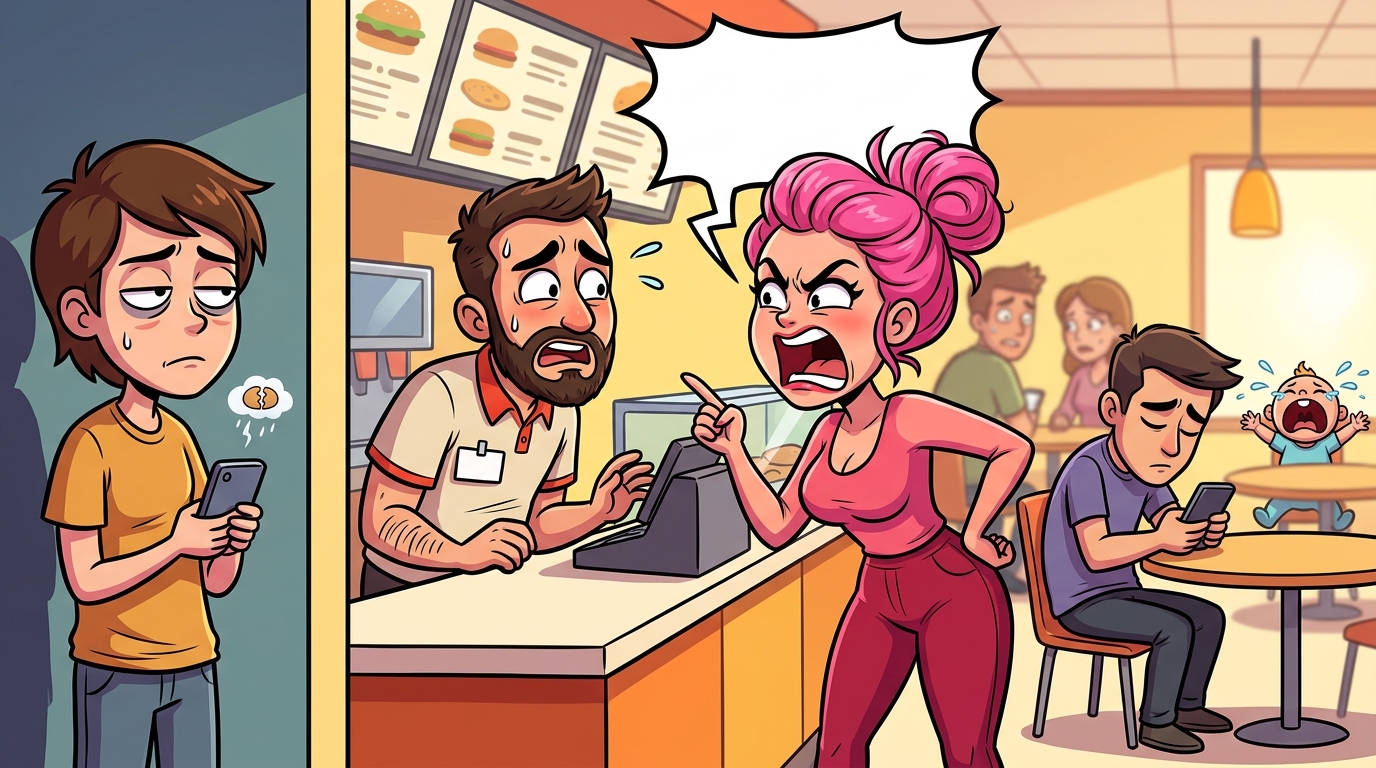
She surveyed the scene, then, with a huff that seemed to communicate her utter disbelief at having to wait, she walked straight to the very front. Not to the next available lane, but to the cashier currently serving an elderly woman painstakingly counting out change. The young woman put her single item, a large bag of expensive-looking chips, onto the conveyor belt and gave the cashier a look that demanded immediate attention.
The cashier, a tired-looking man with a nametag that read ‘Dave,’ blinked at her. He finished with the elderly woman, handed her receipt, and then slowly turned his attention to the young woman. Before he could speak, she began to talk, her voice carrying a clear, almost melodic tone that suggested she was used to being heard. She explained, not to Dave, but to the general area, that she was in a hurry, that her son was very hungry, and that this was simply ridiculous. She even gestured vaguely to the lines as if they were a personal affront.
A few people in line shifted. Someone behind me muttered something about common courtesy. My usual strategy in these situations is to become invisible, to not make eye contact, to simply wait for the storm to pass. But the young woman, having made her point to the universe, then turned her gaze directly to our line, scanning each face as if daring anyone to challenge her. Her eyes landed on mine, and I felt that familiar knot tighten in my stomach. I gave a quick, almost imperceptible shake of my head, hoping she would just move on.
But she didn’t. She looked back at Dave, who was now just staring at her, patiently. She then looked back at me, a smirk playing on her lips. She picked up her bag of chips, making a show of it, and held it out, as if it were an offering of immense value. She told Dave that her son was starving and needed these chips now. The boy, her son, shrank even further, his face flushed.
I knew I couldn’t just stand there. My heart was pounding, a familiar discomfort washing over me. I took a deep breath. She was clearly intelligent, perhaps more so than her current behavior let on. I needed to approach this from an angle that appealed to her perception of herself. I decided to make it about her intelligence and her sense of self-importance.
I took a small step forward, enough to make it clear I was addressing her, but not so much that I was crowding her space. I spoke softly, almost as if sharing a secret, so only she and the cashier and the boy could really hear. I mentioned that it was quite smart of her to know that drawing attention like this could actually slow things down, that people often took longer with customers who were, shall we say, particularly vocal.
She paused, her mouth slightly open, clearly not expecting that particular observation. Her eyes, which had been darting around, settled on mine. I continued, my voice still low, suggesting that someone as sharp as her would surely realize that the best way to get through quickly, especially with a child, was to be so understated, so calmly efficient, that the staff almost felt compelled to move faster just to match her pace. I said it would show a level of class and self-possession that most people in this chaotic store simply couldn’t achieve, truly setting her apart.
She chewed on her lip for a second, a flicker of something calculating in her eyes. It was almost as if she was running a quick calculation. She looked at her son, then at Dave, then at me again. Her gaze lingered on my face, probably trying to deduce if I was mocking her or genuinely admiring her supposed superior intellect. Before she could respond, a sudden, piercing voice boomed through the store’s intercom system. A manager’s voice, tinny and loud, announced a code-five clean-up in aisle nine, urgently requesting all available staff. The sheer volume of it made everyone jump a little, and for a moment, the entire store seemed to collectively flinch.
The young woman blinked. The interruption seemed to break her train of thought, momentarily disrupting her self-important bubble. She looked back at the line, then at her bag of chips. After a beat, she actually smiled, a small, knowing smile that was more for herself than anyone else. She glanced at me one last time, a hint of something like approval in her eyes, as if I had merely confirmed a brilliant idea she had just concocted. She turned to Dave, picked up her chips, and, without another word, walked to the very back of the line, her son trailing silently behind her.
I felt a wave of relief, followed immediately by that familiar urge to retreat into myself. My mind, which had been buzzing with the confrontation, now just wanted quiet. I was still a few people away from the cashier when my phone vibrated in my pocket. It was a text from my sister. She needed me to pick up my niece from her soccer practice, and it had to be right now because she was stuck in traffic. I quickly checked my watch. There was no time to wait. I mumbled an apology to the person behind me, left my full cart in the aisle, and hurried out of the store, the sudden rush of cool air a welcome change from the store’s manufactured chaos. I never saw if she actually bought those chips, or if she made it through her new line without further incident.