
I really do love a good Saturday in the park. The sun was shining, not too hot, just enough of a breeze to rustle the leaves on the big oak trees. People were everywhere, playing frisbee, pushing strollers, or just sitting on benches, soaking it all in. My favorite thing to do on a day like this is find a nice spot, maybe near the fountain, and just watch everyone. I like to imagine their stories, where they’re going, what they’re thinking. I’ve always been good at noticing the little things, like how the park was designed to handle a certain amount of foot traffic, or how the new pedestrian bridge actually creates a bottleneck if too many people try to cross at once. I spent years volunteering for park clean-up days, which meant I got to learn all the nooks and crannies, and more importantly, the specific rules for pretty much every part of the grounds, even the less obvious ones.
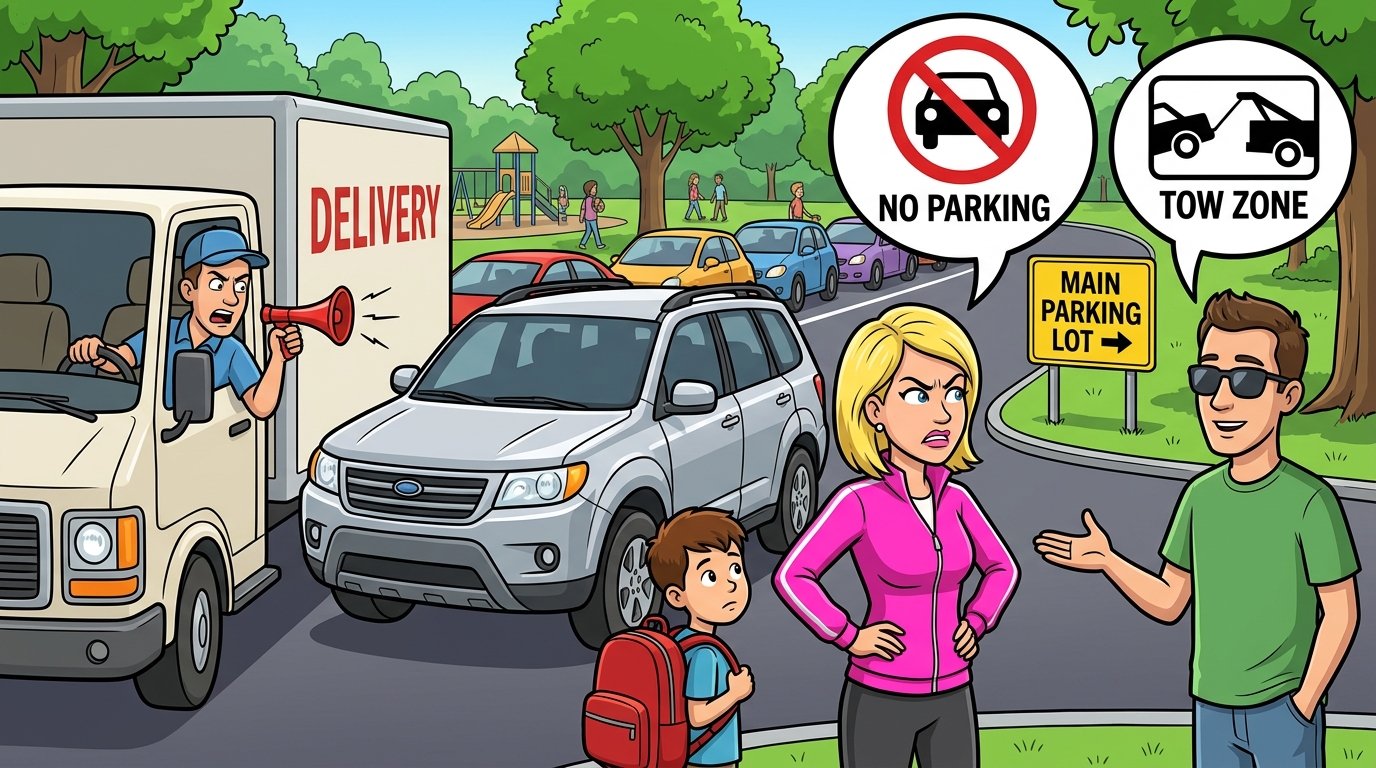
I had just settled onto a bench, ready for some prime people-watching, when a silver SUV pulled into the park’s main entrance. Now, this entrance has a very clearly marked turnaround loop. It’s for dropping people off, not for parking. There are big, bold signs that say NO PARKING, TOW AWAY ZONE. Everyone knows this. But this particular SUV, instead of circling and leaving, just stopped. Right in the middle of the loop, half blocking the path for anyone else trying to come or go. A woman, probably in her late thirties or early forties, with a perfectly styled blonde bob and a bright pink athletic jacket, got out. Her face had that look some people get when they’re a little stressed, like the world isn’t quite meeting their expectations. A small boy, maybe five or six, was in the back seat, already wrestling with his seatbelt.
I watched as she walked around to the passenger side, opened the door, and waited for the boy to finally wiggle free. He had a bright red backpack that looked almost as big as he was. She didn’t seem to notice the other cars slowing down to navigate around her, or the parents with strollers having to veer onto the grass. She just stood there, waiting. After the boy was out and had his backpack settled on his shoulders, she shut the door, gave a quick glance at the line of cars behind her, and then, instead of getting back in to move her vehicle, she just started walking with her son toward the playground. Her car sat there, like a silver island in the middle of a flowing stream.
My first thought was, “Oh, she must be coming right back. Maybe she forgot something.” But then I watched her and the boy disappear behind a stand of trees. Nope, she was clearly going to leave the car there. My natural inclination is always to try and fix things, to make sure everyone is having a good time and that things run smoothly. It just helps everyone. So, after a minute, I stood up and headed toward her car. As I got closer, I saw a delivery truck trying to get into the loop, honking a couple of gentle toots that sounded more like a polite cough than an angry blast. The truck driver, a younger guy with a baseball cap, leaned out his window, looking frustrated.
I walked up to the delivery driver. “Looks like she just abandoned it,” I said, pointing at the silver SUV. The driver sighed. “Tell me about it. This is where I drop off supplies for the snack bar. Can’t even get in.” He pulled out his phone. “Guess I gotta call this in.” He started dialing. I knew that parking enforcement, even if they were available, would take at least half an hour to get here on a busy Saturday. And the chances of them showing up at all if they had bigger emergencies were about fifty-fifty.
I looked at the SUV. It was really causing a mess now. Other cars were trying to squeeze by, some drivers were starting to lean on their horns a little more aggressively. I saw the blonde woman, the “Karen,” as some people might call her, emerge from behind the trees, marching back towards the car. She had her phone pressed to her ear, looking annoyed. I guess she’d heard the growing chorus of horns. She finally got to her car, and instead of getting in, she just stood there, hands on her hips, glaring at the delivery truck and the line of cars. She even gave a little huff, like they were the problem.
I decided to try my luck. I walked up to her, keeping my voice friendly. “Hi there,” I said, giving a small smile. “I think you might have parked in the drop-off zone. It’s actually a tow-away zone, and you’re blocking the delivery truck.”
She lowered her phone, her eyes narrowed at me. “I know where I parked,” she said, her voice sharp. “I’m just picking up my son from a playdate. I’ll be five minutes. They can wait.” She then pointed vaguely towards the snack bar. “My son is only five. I can’t expect him to walk all the way from the main parking lot.”
The delivery driver, who had been listening, piped up, “Ma’am, I’ve got a schedule to keep. And you’re blocking the only access point for my delivery.”
She just rolled her eyes at him. “It’s a park, not a highway. Relax.” Then she turned back to me, as if I was her personal audience. “Honestly, the rules in this park are ridiculous. It’s impossible to find parking, and I just need to get my son his ice cream. He deserves it after a long week.”
I knew arguing with her directly wouldn’t work. Her mind was already made up. I also knew that she wasn’t actually picking her son up from a playdate; she had just dropped him off moments earlier. I had watched her. But calling her out on that wouldn’t help. I needed to think like her, or at least, think for her. I shifted my weight, trying to appear even more relaxed, less confrontational. “You know,” I began, in a thoughtful tone, “I totally get that. Finding parking is a nightmare, especially when you’ve got a little one who’s probably tired and just wants his treat.” I saw a tiny flicker of recognition in her eyes. I had spoken her language.
“I bet you’re already thinking about how much easier it would be if you just found a spot in the main lot,” I continued, making it sound like an observation, not a suggestion. “I mean, if a parking attendant or a park ranger did show up, and they’re usually pretty quick with this spot, they wouldn’t just give you a ticket, they might even tow the car. And then imagine how much longer it would take to get your son his ice cream if you had to deal with all that paperwork and finding a tow yard. He’d probably be really upset, waiting around even longer.” I paused, letting that sink in. I knew from my volunteer work that the tow truck response time for this specific zone was unusually fast because it was a critical access point for emergency services too.
“Plus,” I added, lowering my voice a bit, “I’ve seen it happen. Sometimes they tow with the child’s belongings still inside, and then it’s a whole thing to get them back. I’m sure you wouldn’t want to explain that to your little one. It would probably just stress you out more than a quick drive to the main lot would.” I gestured vaguely towards the proper parking area, which was actually only about a three-minute walk to the playground, not the epic journey she was imagining.
She looked from me to the line of cars, then to the delivery truck, which was still patiently waiting. A thought seemed to slowly connect in her mind. Her brow furrowed, but not in anger at me, more like she was doing some complex math. “Right,” she mumbled, almost to herself. “Yes, the paperwork. And his backpack is in the trunk.” She finally seemed to realize that the inconvenience of moving the car herself was far less than the inconvenience of a towed car, especially with her son’s items locked inside. “I suppose it wouldn’t be worth the hassle,” she concluded, as if she had just come up with the brilliant solution all on her own.
“Exactly!” I said, with a reassuring smile. “You’re so smart to think ahead like that. Better to just get it handled now. You’ll be back with his ice cream in no time.”
She gave a curt nod, a little less stiff now, and finally got into her SUV. She started the engine and, with a last annoyed glance at the delivery truck, slowly drove off, heading towards the main parking lot. The line of cars behind the truck started to move, and the delivery driver gave me a quick thumbs-up before pulling into his spot. I watched her car disappear. I felt a strange mix of relief and a tiny knot of unease. I was glad the problem was solved, but I couldn’t shake the feeling that I might run into her again, perhaps on another park day, perhaps at the grocery store, and she wouldn’t remember me, but I would definitely remember her.