
The fluorescent lights of the electronics section always gave me a slight headache by the end of my shift. Today was no different. I was tidying the rows of video game cases, making sure everything was perfectly aligned. It was a habit I’d picked up from my speedcubing hobby; things just felt right when they were in order. My brain liked puzzles, and making sense of a messy display was a tiny, satisfying one.
A woman approached, her high heels clicking loudly on the polished floor. She looked to be in her early twenties, perhaps twenty-one or twenty-two. Her tight jeans and sparkly top seemed more suited for a night out than a Saturday afternoon at a department store. Her makeup was expertly applied, giving her face a sort of perfect, porcelain look, and she carried herself with an air that suggested she expected everyone to notice her. Beside her, a small boy, maybe four or five years old, was dragging his feet and whining softly. He looked tired.
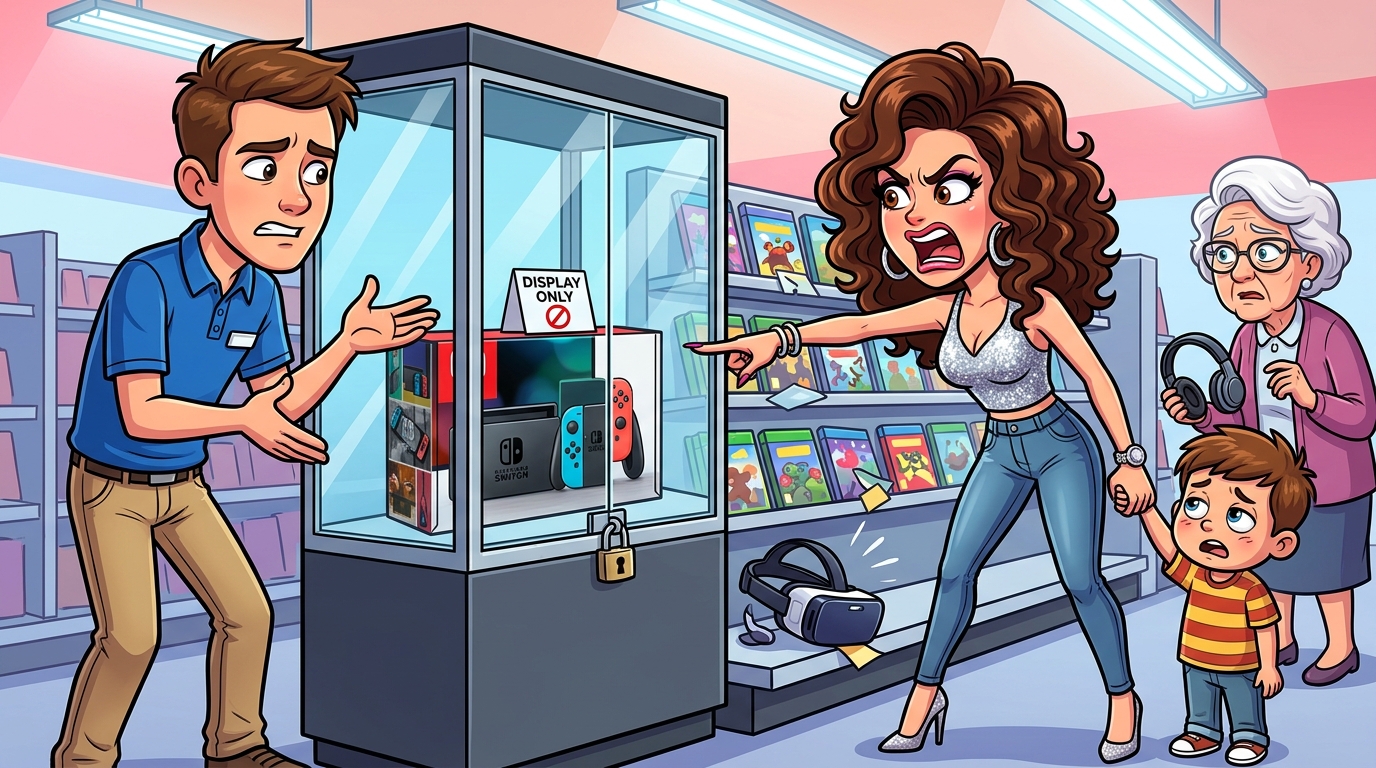
She stopped near the display case where we kept the popular new game console bundles. It was a special edition, very limited, and we only had one left, which was for a customer who had pre-ordered it. The display model was clearly marked with a sign that said, “DISPLAY ONLY – NOT FOR SALE.”
The woman tapped on the glass with a long, manicured finger. She didn’t look at me, but stared at her reflection in the glass, adjusting her hair. The little boy started to tug at her sleeve, wanting her attention. He pointed at the console, saying he wanted to play with it.
I walked over, offering a polite greeting. I asked if I could help her with anything.
She finally turned her head, her eyes scanning me from head to toe with a dismissive glance before settling back on the display. She waved a hand vaguely at the console. She said she wanted that one, referring to the one behind the glass. She added that her son deserved it, and she always got what she wanted.
I explained, as calmly as possible, that the console was a display model. I pointed to the sign, which she barely looked at. I added that the actual stock was already reserved for pre-order customers and that we had sold out weeks ago. I offered to check if any other stores in the area might have one, or if I could set up an order for the next shipment, which was due in a few months.
She gave a short, humorless laugh. She told me she didn’t have time for that. She said she was special, and that she wasn’t going to wait. She pointed out that I could just give her the display model. She said it wasn’t fair for her son to want something so badly and not get it, especially when it was right there. Her voice started to get a little louder, attracting the attention of a few other shoppers.
The little boy, sensing his mother’s rising frustration, began to whine more loudly. He reached out and tried to grab a small, expensive VR headset from an open display shelf. I quickly but gently moved it out of his reach. The woman didn’t even seem to notice his actions.
I repeated that the display model was not for sale and that taking it would mean we couldn’t show other customers what the product looked like. I tried to explain the logistical reasons, thinking a clear explanation would appeal to reason. She just looked at me with an expression that said she found my words utterly irrelevant. She insisted that it would be fine and that I should just make an exception for her. She made a point of looking around the store, as if expecting someone important to step in and agree with her. She then said I clearly didn’t understand how important she was, and that managers always listened to her.
An older woman, with soft white hair and kind eyes, who had been looking at headphones nearby, paused and looked over at us. She adjusted her glasses, her expression one of gentle concern. She then spoke up, in a quiet but firm voice, saying that the young man was just doing his job and that it wasn’t right to yell at him. She added that her grandson loved the display models because he could see how they worked, and it helped him decide what he wanted for his birthday.
The young woman snapped her head towards the older lady, her eyes narrowing. She told the older woman to mind her own business and that this had nothing to do with her. She then scoffed, mentioning that some people just didn’t understand quality when they saw it.
The older woman simply shook her head and went back to looking at the headphones, though I could tell she was still listening.
I took a deep breath. This was a classic. The demands, the sense of exceptionalism, the immediate dismissal of anyone who disagreed. I realized a logical explanation wasn’t going to work. My next move was to de-escalate without giving in. I told her I understood her frustration, but rules were rules. I offered one last time to call another store or set up a special order. When she loudly refused, I told her I would need to get my manager involved, as I was unable to override store policy. I walked over to a nearby service phone and pressed the button for management, explaining the situation briefly to the person who answered.
While I waited, the young woman leaned over the display case, pulling at the small lock. The little boy, seeing her mother’s actions, began to try and pull a stack of game controllers from a lower shelf, his small hands grappling with the packaging. I quickly moved towards him, just as my manager, Mark, rounded the corner. Mark was a big guy, calm and always fair, with the kind of unflappable patience that came from years in retail.
Mark took in the scene: the frantic child, the woman trying to open the display, the slightly annoyed older customer. I quickly and clearly explained the situation to Mark, sticking to the facts: she wanted the display model, I explained policy, she refused options, and her son was being destructive. I made sure to mention the grandmother’s intervention as well.
Mark listened carefully, nodding. He then turned to the young woman. He told her in a firm, clear voice that the display model was not available for sale. He then addressed her attempts to open the case and her son’s actions with the controllers. He said that because of her behavior and her refusal to respect store policy, she would need to leave the store. He stated that we did not tolerate disrespectful behavior towards staff or other customers, nor damage to store property.
Her face, which had been set in a look of self-importance, crumpled into genuine shock. She started to argue, raising her voice even louder, asking if he knew who she was. She claimed she was a loyal customer and couldn’t believe she was being treated this way. She glanced at the older woman, who was now openly staring, and then back at Mark.
Mark simply repeated that she needed to leave. His voice was calm but unwavering. He said if she refused, he would have to call security. The threat of security seemed to finally register.
She gathered her small son, who was now confused and starting to cry, and practically stormed out of the section. Her heels still clicked loudly, but this time, they seemed to echo her frustration rather than her confidence. As she passed the older woman, she shot a venomous glare, but the older woman simply offered a small, sympathetic smile.
Mark sighed, then turned to me with a small grin. He thanked me for handling it professionally. I went back to straightening the game cases, the order in them a small comfort after the chaotic encounter.