

Hello everyone. I have a situation at my job, and I am needing to know if I am the jerk here, or if my boss is being unfair.
I am working as a Senior Database Architect for a big company. My job is very complex and it needs many years of special education and experience. I am designing systems, optimizing performance, ensuring data integrity for very large and important databases. This work is critical for the business, and it is what I am paid very good money to do.
Last week, our administrative assistant, Sarah, she got very sick and could not come to work. Sarah’s job is mostly data entry. She types information from physical papers into our computer system. It is very repetitive work, needing speed and attention to detail, but it does not need high-level thinking or special technical skills like my job.
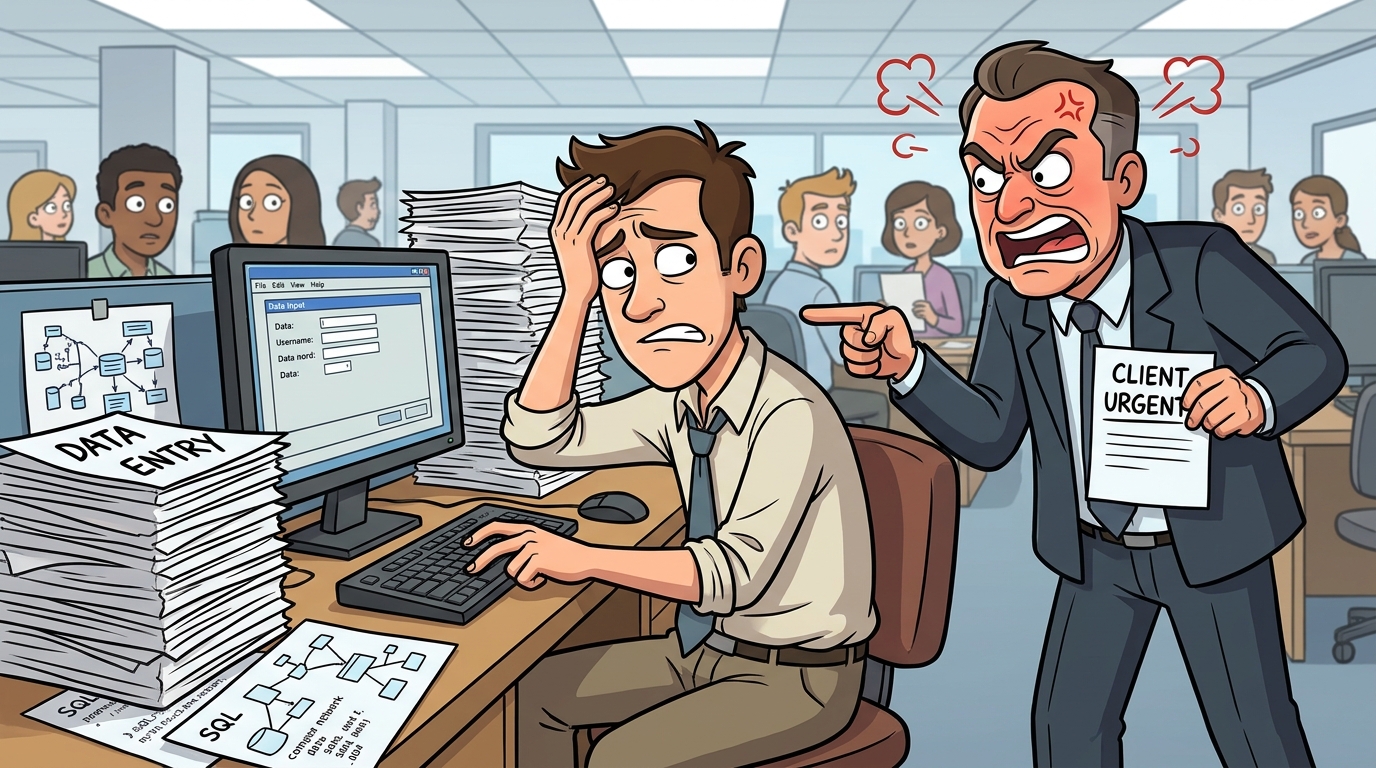
On Tuesday morning, my boss, Mr. Thompson, he came to my desk. He seemed a little stressed. He said, “We have a huge batch of urgent client data that needs to be entered into the system. Sarah is out, and we cannot afford any delays. Can you please help us for a few days, just until Sarah comes back, or we find a temporary person?”
My mind was shocked. Me? A Senior Database Architect? To do data entry? This felt like a direct insult to my professional capabilities and my entire career path. I am a specialist. My time is very expensive. To ask me to do the work of an entry-level admin, it felt like asking a surgeon to sweep the operating room floor. It was not using my skills, it was not using my brain, and it was certainly not what I am paid for. I felt very disrespected. But, I am a team player, I told myself. So, I said, “Okay, Mr. Thompson. I will help. But this is not my area of expertise, so it may take me longer.” He just nodded and looked relieved.
So, I went to the admin desk. There was a mountain of papers. I began to type. But as I typed, I was thinking. If they want me to do this kind of work, they must understand the consequences. They must see how inefficient it is to take a highly specialized resource and make them do generalized, unskilled labor. I am not trained for fast typing. My fingers are for complex SQL queries and system configurations, not for quickly inputting numbers. So, I typed slowly. I focused on making sure every single number was absolutely correct, because accuracy is always important, yes? So I checked each field two, three, sometimes four times before moving on. I would pause often. I would “accidentally” misplace a paper and spend a long time looking for it, just to ensure all the data was there. When a colleague would pass by and ask, “How is it going?” I would sigh and say, “Oh, it is very challenging, this detailed work. I am doing my best, but it is taking me much longer than I expected. My mind is not built for this kind of repetitive task.”
I also made some small “errors” that were easy to fix but would definitely be flagged by the system and require review. For example, I might put a client’s ID in the ‘account number’ field instead of the ‘client ID’ field, or I might use a slightly different date format than the system preferred. These were not big mistakes, but they showed I was not “familiar” with the specific nuances of the data entry process. If anyone asked, I would say, “Oh, my apologies, the interface is not intuitive for someone who works with backend systems. I am learning.”
After two days of this, Mr. Thompson came to my desk again. His face was very red. “What is going on, [My Name]?” he demanded. “You have only entered about 10% of the data. Sarah usually finishes this much in half a day! And the system is flagging so many errors that someone has to go back and manually review all your entries before they can be processed!”
I looked at him calmly. “Mr. Thompson,” I said, “I told you, this is not my expertise. I am a database architect. My job is not data entry. I tried my very best. I was very careful for accuracy, because we cannot have mistakes with client data, yes? It is just that this work is not suited to my skillset. Perhaps now you can see why we have a dedicated person for this specific function.”
He got very angry. He said I was sabotaging the process, that I was being uncooperative. He said it was an “all hands on deck” situation and everyone needed to pitch in. I countered, “Yes, but my ‘hands’ are for database architecture, not for typing. You asked me to help, and I did. But you cannot expect a brain surgeon to perform a tooth extraction with the same speed and efficiency as a trained dentist, can you? It is about using the right tool for the right job.” He called me dramatic and unprofessional. He accused me of doing it on purpose to prove a point. I told him, “Why would I do it on purpose? I was just trying my best. It is not my fault that I am slow at something I am not trained for, especially when it is so far from my area of expertise.” I reminded him that if he had given me a complex database problem, I would have solved it quickly and efficiently. But this was not my role.
Now, because of the delay, the client is very upset. Sarah is still out sick. Other colleagues had to work late, fixing my “errors” and finishing the data entry. Mr. Thompson said my “attitude” is a serious problem and he is considering disciplinary action. He said I showed “malicious compliance.” But I was just being honest about my capabilities and showing the reality of asking a specialized resource to perform general work. I believe I made a very clear point about efficiency and job roles.
Am I The Jerk here? Was I wrong to show them what happens when you misuse a specialized resource? I feel like I was just proving a point about efficiency and the importance of specific job functions. People should understand that everyone has a specific function and expertise.