
The Saturday morning sun was doing its best to shine through the tall, narrow windows of “The Daily Grind,” but mostly it just highlighted the dust motes dancing in the air. I was tucked away in line, probably about a dozen people deep, with my usual internal rhythm. I don’t really mind waiting. It gives me a chance to just… observe. To let my thoughts drift, maybe about the peculiar patterns on the small river rock I’d found last week and currently kept in my pocket. My turn would come when it came. The smell of fresh coffee and warm cinnamon rolls hung heavy, a comforting cloud that promised good things.
The line was moving, slowly but surely. Most people were looking at their phones, or chatting quietly, or just staring off into space like me. Then she arrived. A woman, maybe in her late forties, with a perfectly coiffed blonde bob and a bright, almost aggressive, floral blouse. She had a man with her, who I guessed was her husband. He was slightly heavier, wearing a polo shirt, and already had that resigned look in his eyes that suggested he’d seen this show many times before. They walked right past the end of the line, not even pausing, and headed straight towards the front. My gaze, just like a few others, followed them.
The woman stopped short, about five people from the front. She didn’t join the line, not really. She sort of just… hovered there, a small, impatient bubble of energy. Her husband, to his credit, gave a small, almost imperceptible sigh and pulled out his phone, pretending to be very interested in whatever was on the screen. The woman kept craning her neck, tapping her foot, and making small huffing noises. I could hear her muttering under her breath, something about “ridiculous wait times” and “people who clearly have all day.” It was almost endearing in its predictable entitlement, like watching a perfectly rehearsed play where you already knew all the lines.
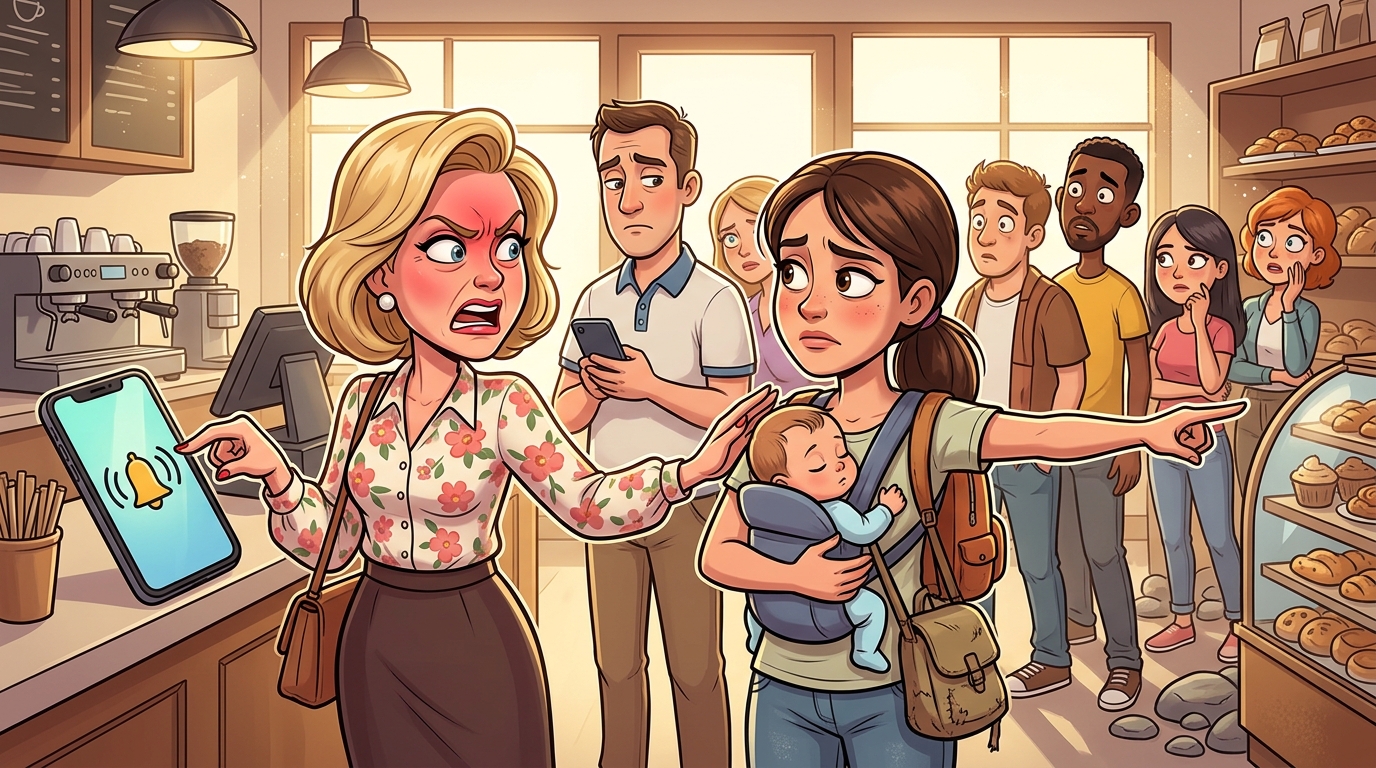
A few more minutes crawled by. The line advanced another couple of steps. The woman’s impatience was growing, a visible aura around her. She exchanged a quick, frustrated glance with her husband, who just shrugged and made a “what can you do?” face without looking up from his phone. Then, without a word, she made her move. She took a deep breath, puffed out her chest a little, and slid past the person directly in front of her. That person was a young woman, maybe early twenties, holding a baby carrier with a sleeping infant inside. She had a soft, tired look on her face, and her small, worn backpack suggested she wasn’t having the easiest morning.
The young woman, let’s call her Sarah, looked up, surprised. The blonde woman was already trying to push past the next person. Sarah, in a quiet voice, said, “Excuse me, the line starts back there.”
The blonde woman stopped, turning slowly. She gave Sarah a look that was a mix of disbelief and annoyance, as if Sarah had just uttered a profound insult. “Oh, honey,” she said, her voice dripping with condescension, “I just need to grab a quick coffee. Some of us have important things to do today.” She gestured vaguely towards the door, as if an urgent meeting was waiting for her outside, perhaps involving world leaders or highly volatile stocks.
Sarah’s tired expression tightened. She wasn’t aggressive, just firm. “We all need a quick coffee. And we’re all waiting. The line is back there, at the end.”
The blonde woman let out a short, humorless laugh. Her husband, I noticed, had finally looked up from his phone, a flicker of apprehension in his eyes. “You don’t understand,” she said, raising her voice slightly so more people could hear. “I’ve been waiting for ages. This is ridiculous. I just need a latte, a simple order. It won’t take but a second.” She paused, as if expecting everyone to nod in agreement and part for her. When no one did, her face started to turn a slight shade of pink.
I found myself getting a little annoyed. My usual detached observation was giving way to a dull throb of irritation. It wasn’t the queue jumping itself, it was the sheer conviction in her voice that her desire somehow trumped everyone else’s right to fairness. Her husband shifted his weight, looking at his shoes, then quickly back at his phone. He clearly wanted no part of this.
Suddenly, a shrill, tinny ringtone erupted from the blonde woman’s large, designer handbag. It was one of those annoying, high-pitched electronic tunes that grated on the ears. She fumbled inside the bag, her movements jerky and frustrated, making it even harder for her to focus on her argument. The sound just added to the general chaotic energy that was now emanating from her. She finally pulled out a sleek smartphone and barked into it, “What? I’m in line, well, I’m trying to get my coffee. Yes, I’m coming. Don’t be so dramatic.” She then ended the call with an aggressive jab of her thumb.
“Look,” she said, turning back to Sarah, her voice even louder now, “I really don’t have time for this. Just let me through.” She made another move to step around Sarah.
That was enough for me. My own patience snapped. “No,” I said, my voice a little louder than I intended, cutting through the lingering echo of her terrible ringtone. “She’s right. Everyone else is waiting. You need to go to the back of the line, just like everyone else.” I felt a sudden rush of something hot, a righteous indignation that surprised even me. My perceiving nature usually meant I’d prefer to just let things be, but this was too much. The pure audacity was offensive.
The blonde woman whipped her head around, her eyes widening as if she couldn’t believe someone else was speaking. Her mouth opened and closed a few times before she managed to sputter, “Who do you think you are? This doesn’t concern you!”
“It concerns everyone in this line,” I retorted, matching her energy now. My tone was sharp. “You think your time is more valuable than hers, or mine, or anyone else’s? That’s not how it works.” I felt a strange mix of exhilaration and dread. I rarely got into public confrontations, but the injustice of it just felt so clear.
She was clearly not used to being challenged by more than one person. She stammered, “I have an appointment! A very important one! I can’t be late because of… of this.” She waved her hand dismissively at the line, encompassing all of us, the patient and the annoyed alike.
Sarah, who had been watching me, took a deep breath. She looked towards the counter. “Can we get a manager, please?” she called out to one of the baristas, who looked harried but nodded and disappeared into the back room.
The blonde woman scoffed. “A manager? For this? You people are ridiculous!” She looked around, expecting sympathy, but mostly she was met with stony faces and a few people actively turning away. Her husband had completely withdrawn, staring intently at his phone again, as if willing himself to become invisible.
The barista reappeared without the manager. They just gave a shrug that seemed to say, “They’re busy.” The line, despite the commotion, kept moving forward, inch by painful inch. The blonde woman, perhaps sensing that the manager wasn’t materializing and that she wasn’t gaining any allies, made a quick, decisive calculation. She let out one final exasperated sigh, rolled her eyes at Sarah, and then just sidled in front of her. She effectively squeezed herself into the space, completely ignoring Sarah’s quiet protest. She stepped right up to the counter, pulled out her wallet, and barked her order at the bewildered barista. The barista, perhaps trained to keep the line moving at all costs, took her order and started making her drink.
Within what felt like seconds, she had her latte and a small pastry. She paid, gave a triumphant, self-satisfied smirk that lingered just a moment too long, and then walked out of the bakery with her husband trailing silently behind her. He didn’t even look back. The manager never showed. The noise level in the bakery settled back down to its usual hum of quiet chatter and espresso machines.
Sarah, the young woman with the baby, was next in line. Her shoulders slumped a little as she stepped forward. She looked at me, a small, sad smile on her face. I just offered her an empathetic nod. She didn’t say anything, just quietly ordered her coffee and a croissant. As she waited, she gently adjusted the blanket over her sleeping baby. I watched her, feeling a profound sense of unfairness. She had done everything right, had stood her ground politely, and still, the entitled woman had gotten her way, completely unbothered by her own behavior or the inconvenience she’d caused. I just wanted to tell Sarah how sorry I was that she had to deal with that, but I knew it wouldn’t change anything.