
The late afternoon sun in the community garden was a perfect shade of golden, warm on my skin but not oppressive. I had found a quiet spot on a low stone wall, just beside a patch of lavender buzzing softly with bees. My habit of truly seeing things, rather than just glancing, meant I noticed the subtle rustling of leaves in the breeze, the exact gradient of color on a rose petal, the precise rhythm of a robin’s song. It was a comforting way to spend an hour or two, just absorbing the small, tangible facts of the world around me.
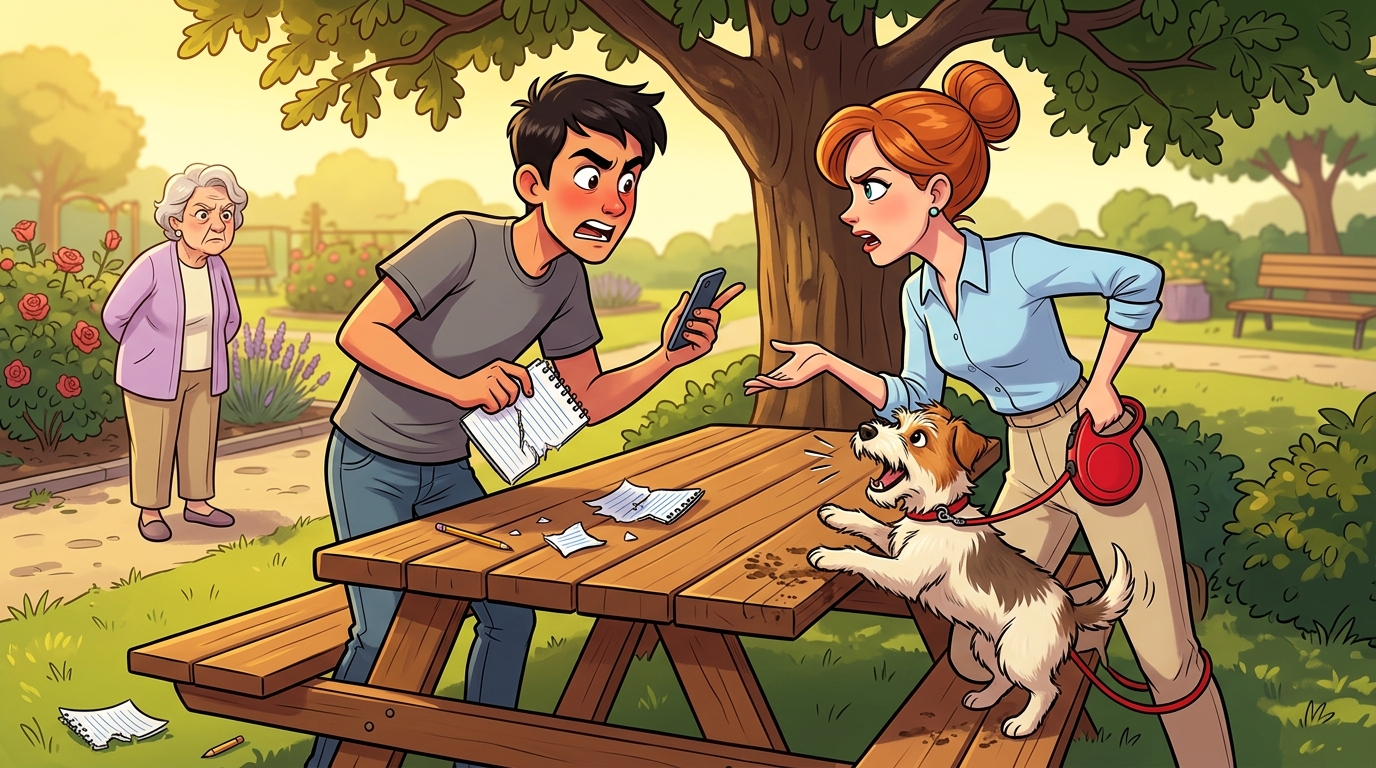
Across the neatly kept lawn, under a mature oak tree, a young man sat at one of the heavy wooden picnic tables. He was focused on something in a notebook, his brow furrowed in concentration. His posture was relaxed but attentive, his dark hair falling just a little over his eyes as he leaned forward. He appeared to be in his early twenties, maybe twenty-three or twenty-four, dressed simply in a plain t-shirt and jeans. The table he occupied was one of the prime spots, offering both shade and a good view of the garden’s central fountain.
About ten minutes later, a woman entered the garden with a small dog on a bright red retractable leash. She walked with purpose, her gaze sweeping across the various seating areas. Her hair, a striking, almost iridescent shade of copper, was pulled back in a neat bun. She carried a large canvas bag over one shoulder, and I could just glimpse a small, elaborate gold-plated travel tea set peeking from the top. I had observed her before, always with her specific blend of herbal teas for what she often announced to anyone nearby were “optimal digestive health benefits.” She seemed particular about many things, from her footwear to the specific brand of organic, grain-free treats she carried for her dog. The dog, a fluffy terrier mix with bright, intelligent eyes, was already pulling at its leash, sniffing at every bush and flowerbed. It was a small creature, but it possessed a surprising amount of energy and a vocal repertoire that seemed to defy its size.
The woman, after a brief survey, fixed her attention on the young man’s table. She began to walk in a slow, deliberate circle around his spot, her dog straining at the leash, letting out short, sharp barks at passing butterflies. The young man, seemingly lost in his thoughts, did not look up immediately. The woman cleared her throat, a little louder than necessary, then made a soft tsking sound.
The young man finally lifted his head, his expression one of mild inquiry. He offered a small, polite smile.
The woman stopped, hands on her hips. She gestured vaguely at the table. “This spot,” she stated, her voice carrying a tone of mild command, “is quite perfect for my afternoon tea. The light is just right for my digestion.” She did not ask if the table was free, or if he would mind moving. Her phrasing suggested a simple statement of fact, a declaration of intent that she expected to be obeyed without question.
The young man’s smile faltered slightly. He glanced around the park. There were other benches, other small, two-person tables scattered around, though none quite as central or shaded as his. “I am sorry,” he responded, his voice still gentle, “but I am using this table at the moment. I have been here for a while.”
The woman’s expression did not change. Her dog, meanwhile, decided to investigate a patch of newly planted marigolds nearby, digging with surprising speed. The woman tugged gently on the leash, her attention not entirely on the dog. “Oh, I see,” she said, though her tone suggested she did not see at all. “But my needs are rather specific. This angle of sunlight, you understand, for my herbal infusions. It is quite important.” She took a step closer to the table, her shadow falling over his notebook.
The young man’s patience seemed to thin slightly. He carefully placed his pencil down. “I understand you have your reasons,” he replied, a little more firmness in his voice, “but I was here first. There are other spots.”
The dog, having successfully uprooted a marigold, shook its head enthusiastically, spraying soil. The woman gave a short, irritated sigh. “Fido, no!” she commanded, but without much force. She then looked back at the young man, a flicker of something almost like disdain in her eyes. “Well, perhaps you could simply move your things to one of the smaller benches. This table truly suits my particular setup. It is a four-person table, after all, and you are only one person.”
The young man stood up slowly. His initial tolerance had evaporated. His face, which had been calm, now showed a tight line around his jaw. “No,” he said, his voice now matching her tone, firm and unwavering. “I am not moving. I was here first, and I am using this table.”
The woman seemed genuinely taken aback by his refusal. She stepped even closer, her dog now trying to scramble onto the edge of the picnic table, its muddy paws leaving marks. “Do you understand who you are speaking to?” she asked, her voice rising in pitch. “I am a regular here. My routine is essential. You are simply being inconsiderate.”
Suddenly, an elderly woman, who had been quietly tending to a rose bush nearby, slowly straightened up. She moved with a thoughtful pace towards them. “Excuse me,” she said, her voice soft but clear, “but there are plenty of other places to sit, Margaret. The young man arrived first.”
The copper-haired woman, Margaret, spun around, her face now a shade of indignation. “This does not concern you, Eleanor!” she snapped, dismissing the elderly woman with a wave of her hand. “My digestive health depends on this precise location, and I have a schedule to keep!” Eleanor, unfazed, simply shook her head and quietly returned to her roses. This brief diversion seemed to ignite an even stronger fire in Margaret.
The dog, sensing the heightened tension, began to bark incessantly, a high-pitched, piercing sound that cut through the gentle hum of the garden. It jumped excitedly against Margaret’s leg, then began to try and pull her towards the young man, as if urging her on. Its leash slipped through Margaret’s fingers for a moment. The dog immediately darted forward, grabbing a corner of the young man’s notebook in its teeth. It shook its head, tearing the paper with a small ripping sound. The young man, in a flash, snatched the notebook back, his expression now one of pure fury.
“That is quite enough!” the young man yelled, his voice echoing slightly in the calm air. He pulled out his phone, his fingers flying across the screen. “I am calling the park rangers. This is absolutely ridiculous.”
Margaret scoffed, though her eyes held a flicker of something like surprise, perhaps even a hint of alarm. “You will do no such thing! This is my park! You cannot simply call rangers on a person for wanting to enjoy their afternoon tea!” She moved to try and grab his phone, her dog still barking wildly at his feet, tangled in her legs.
Just then, a loud, insistent honk from the street caught my attention. My car. I had completely forgotten the parking meter. I glanced at my watch; it was nearly out of time. I had to leave immediately, or I would certainly face a ticket. I stood up, grabbing my bag, my eyes still fixed on the scene unfolding. The young man was now loudly explaining the situation into his phone, his voice sharp with anger. Margaret, her face red, was still trying to argue, gesturing wildly with one hand while trying to corral her yelping dog with the other. I saw a flash of a green uniform through the trees, perhaps a park ranger approaching the garden entrance. But I could not be certain. I had to go. I sighed, feeling a deep sympathy for the young man, whose quiet afternoon had been so thoroughly destroyed. I turned and walked quickly towards the garden gate, leaving the chaos behind me, the sound of the dog’s frantic barking fading with each step.